
How I helped a supply-chain department become email efficient
The results were in! After a department-wide survey at Goodman Fielder on capability, communication skills showed up as the biggest gap.
The 180-strong department worked in logistics, import-export, transport, and customer experience.
Their Senior People and Culture Partner, Damen Blanch, got in touch. Could we help with emails?
Of course!
What they asked for
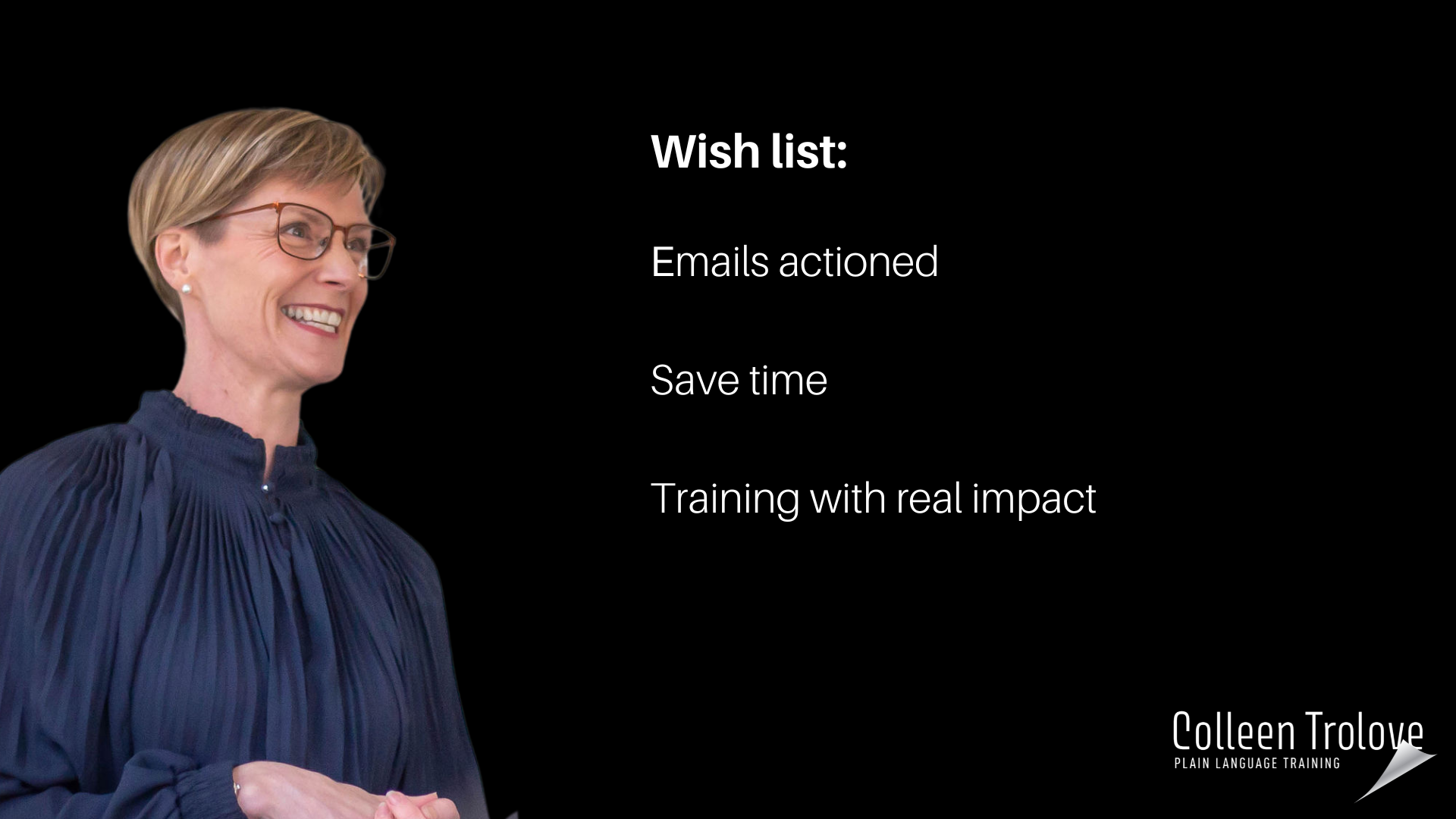
This was the wish list.
Better Supply Chain email writing as part of a larger Effective Communications programme
Get emails read and actioned, save time
Help people consider whether email is even the right channel
Training with real, measurable impact
I saw the sign
Just like Ace of Base, I saw the sign – actually, two signs – that this was going to be a fantastic piece of work.
First, Damen understood that external training (like mine) needs internal support to ‘take’. He chose to be the follow-up person.
Side note: training is like planting a zucchini seedling
A seedling takes 1 day to plant. One and done. You can leave the seedling alone and it will probably grow – they’re hardy plants. But if you want a flourishing bush so covered in zucchinis it will overwhelm even the most devoted ratatouille fan, you need to water it regularly.
Damen planned in advance how he’d water the plant. That’s rare and admirable.
Second, Andy Watson, the Head of Planning, told me “Ninety-nine percent of communication breakdown is on the sender”.
It’s a bold statement to make, but it’s true. And it’s rare someone knows that. This showed me he’s a ‘take responsibility’ kind of guy. Plain language would be a hand-in-glove fit for his team.
What I delivered
We ran a pilot 1-day workshop that Damen and Andy attended. We focused on crisp, clear emails in plain language.
Damen spoke at the start and end of the workshop to link its purpose to people’s desire for better communication skills across the board.
He also told people he’d organise lunchtime catch-ups where they could swap notes about the easy and tricky aspects of changing their email behaviour.
On the training itself…
I made sure people understood that the core elements of plain language could apply to anything the people write. But with our particular focus, all of the activities were about creating powerful, simple, effective emails that could be read, understood, and replied to at speed.
And yes, we worked out the criteria for when an email is the best way to communicate, and when picking up the phone is the better choice. 😊
I’m a big believer in discovery learning
This is when the trainer creates activities that allow people to discover a learning point for themselves. It’s much more powerful than being told theory. I used discovery learning and a multitude of activities to take people as far as I could as quickly as I could.
How did people react to the pilot?
The ever-efficient Damen ran a survey at the end of the training. His email to me said:
The feedback is overwhelmingly in favour!
Satisfaction rating of 4.92 out of 5.
“Would you recommend” – NPS of 100 (I’ve never seen this!).
Comments strongly in favour of workshop … and you!
Minimal “could do better” suggestions.
I acted on those could-do-betters, and then we made the training available to everyone in the department, over the course of a year.
The changes we saw
Thanks to the training and Damen’s ‘co-lab’ follow-ups, this department has seen long-term change. Damen wrote to me recently:
The learnings are showing up!
We are seeing examples of the learnings bouncing around emails. Feedback has been overwhelmingly positive – driving faster response rates.
Even one of our customers commented:
“Have you been to a workshop? Your emails are so much clearer!”
A bonus for me
I now have Damen’s model of pro-active follow-up to suggest to my other clients. His simple commitment to host discussions with people a few times after the workshops is powerful on many levels.
It shows the organisation ‘means it’ – that acting on the training is an expectation, not a nice-to-have.
It shows the organisation cares about its people. They said in a survey that they wanted this capability, and Damen has demonstrated his full support to help them grow in it.
Getting together after training builds a team commitment to make plain-language emails the new normal.
Want your suppliers calling you up to rave about the emails from your team? Get me in!
Get in touch with me: 0211606042
colleen@colleentrolove.com