
We're less literate than you think
Years ago I worked in Wuhan, China, for 9 weeks as an English teacher. Yes, that Wuhan. Covid's birthplace. City of stolen bicycles and tahini-covered breakfast noodles.
My New Zealand employer asked me to go, and I said yes on the spot. (Travel! Adventure! Culture!) I left as soon as the visa came through, having not learned a word of Mandarin. I didn't know ni hao or zai jian, hello or goodbye. I couldn't count to 10.
I was below Level 1 on the literacy scale.
By the end of my time there, my students had introduced me to enough words that I could spot 中国 'China' and 人 'person' on signs. I could read numbers. They'd made a Mandarin version of my name, which I could recognise and write.
I was approaching literacy level 1.
Reading ability is a scale
"Everyone can read! If they can't there's something wrong with them."
Do you think that? I used to.
We talk about reading in binary language, like it's something you 'can' or 'can't' do.
But once you've started to learn a language, you realise that reading is actually a sliding scale of abilities.
In international adult literacy studies, they use a 5-level scale to describe these abilities.
Here's NZ's range of abilities in the most recent study we participated in.
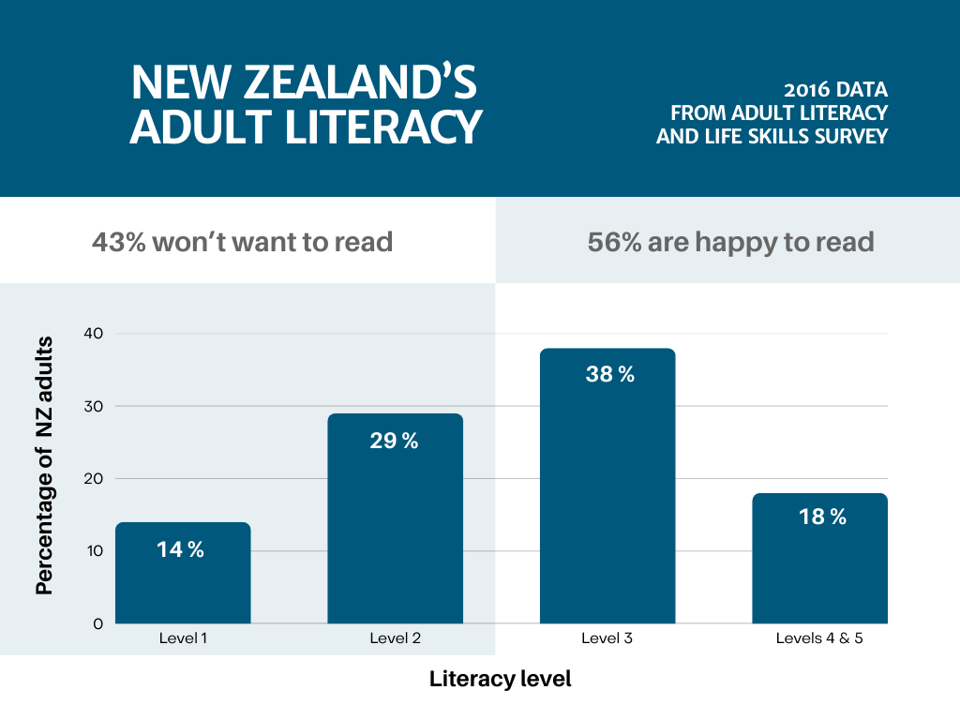
A sobering picture, right? Only half of us want to consume written information.
14% of us feel like me in China, drowning in a sea of characters that mean nothing, with the odd moment of excitement when something familiar jumps out. This is level 1.
29% of us can get by, reading enough to make it through life. But it isn't fun. It's very hard work and we struggle. We'd much rather receive 1-line emails, or talk to workmates rather than read their messages. This is level 2.
You probably have some level-2ers at your workplace.
Read my blog to for a breakdown of all the literacy levels
We're good internationally
We're the fifth most literate nation in the OECD, jostling Australia for fourth position.
In the big scheme of things, we're not terrible readers or poorly educated.
It's just that some of us have more literacy privilege than others.
How can you write to take account of mixed literacy?
Pick simple words. Put them in short sentences. Most of the time, write less than you want to.
More people will read more of your writing.
✨ Sign up for regular writing tips – get new tips direct to your inbox every 2 weeks
✨ Check out my Write Better Emails course, where I help you reclaim your email power!
✨ Look into the School of unProfessional Writing to learn about plain language at your own pace